


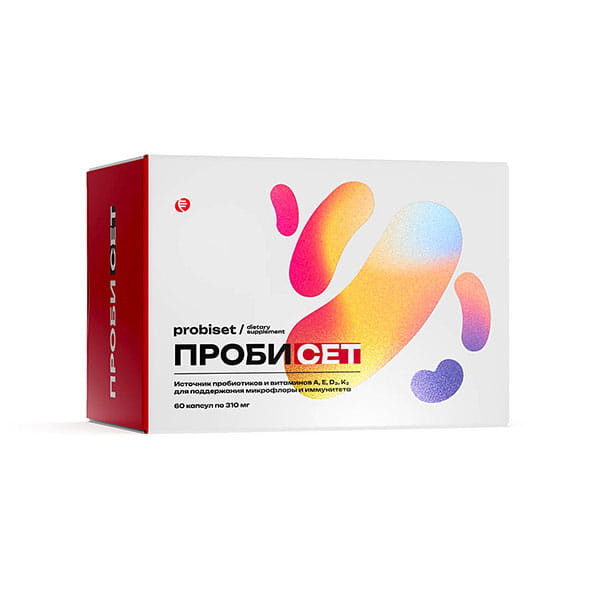
Probiset
category: food supplement
barcode:
packing: 60 capsules
Live culture complex with an enzyme fraction and vitamins A, E, D3 and K2
Probiset® brings together three components that work on the same problem from different directions: five characterised live bacterial cultures, a cell-free Bacillus subtilis fraction carrying enzyme activity, and four fat-soluble vitamins - A, E, D3 and K2. The composition follows a clear logic. Live cultures contribute to the microbial population of the intestine. The B. subtilis metabolite fraction supplies enzymatic activity that the cultures themselves do not provide. And the vitamins address precisely the nutrients whose uptake depends most heavily on a functioning digestive tract.
That last relationship deserves attention, because it is frequently overlooked. Vitamins A, E, D3 and K2 are all fat-soluble, and their absorption requires bile, intact villi and an undamaged mucosal surface. When digestion is compromised, these four are among the first to become marginal and the deficiency develops without obvious signal. Slower tissue repair, drier skin, reduced resistance during the winter months, and declining bone mineral density silently over years. Combining the cultures with the vitamins addresses the mechanism and its consequence in a single formulation.
The bacterial composition is worth reading carefully, since each strain is identified to the level European practice expects. Bifidobacterium adolescentis ARTB-127 is the bifidobacterium characteristic of the adult colon, the species epithet refers to the age at which it becomes dominant and its share of the population tends to diminish with each decade. Lactobacillus rhamnosus ARTB-180 and L. plantarum ARTB-190 are acid-tolerant, robust strains. Streptococcus thermophilus ARTB-188 is the classical yoghurt culture and a producer of lactase.
Propionibacterium freudenreichii ARTB-137 will be familiar to most people without their realising it. This is the organism responsible for ripening Swiss-type cheeses, where it generates both the characteristic aroma and the holes. It ferments its substrate into propionic and acetic acid, short-chain fatty acids that serve as an energy substrate for the colonic epithelium and it is among the few food-grade bacteria capable of synthesising vitamin B12 and menaquinones of the K2 group. A pleasing coherence, given that the formulation supplies K2 directly as well.
The Bacillus subtilis component operates on an entirely different principle. It is a cell-free culture liquid: the metabolites the organism produced, collected without the organism itself. This fraction carries enzymes involved in the breakdown of food along with compounds active against unwanted flora. Since it contains nothing living, gastric acidity, storage temperature and concurrent antibiotic therapy have no bearing on it whatsoever.
FIELD OF APPLICATION:
- periods of dietary disruption, travel or irregular working patterns
- recovery of intestinal microflora during and after antibiotic therapy
- abdominal distension, heaviness after meals and irregular transit
- insufficient enzymatic breakdown of food
- reduced resistance during seasonal periods of increased load
- impaired absorption of calcium, iron and fat-soluble vitamins
- insufficient dietary intake of vitamins A, E, D3 and K2
- age-related decline in bifidobacteria populations
- reduced tolerance of milk sugar
- maintenance of normal bone mineralisation
- condition of skin, vision and mucous membranes
- general support of intestinal barrier function
BENEFITS:
The vitamin component of the formulation carries the effects that have been formally established. Vitamin D3 contributes to the normal absorption and utilisation of calcium and phosphorus, to the maintenance of normal bones, teeth and muscle function, and to the normal function of the immune system. Vitamin A contributes to the maintenance of normal mucous membranes, skin and vision, to normal iron metabolism, and likewise to normal immune function. Vitamin E contributes to the protection of cells from oxidative stress. Vitamin K contributes to normal blood clotting and to the maintenance of normal bones, an effect mediated through osteocalcin, the protein that binds calcium into bone tissue rather than allowing it to settle in arterial walls.
Around these established effects sits the biotic architecture of the product. The live cultures are selected for viability and for tolerance of acid conditions, which is what determines whether a culture reaches the colon in usable numbers at all. The bifidobacteria and lactobacilli in the formulation belong to genera that occur naturally in the human intestine and participate in parietal digestion at the intestinal wall. The B. subtilis metabolite fraction contributes enzyme activity relevant to the breakdown of food, often the element missing when distension and heaviness persist in spite of a sensible diet. Together with the vitamins, the composition is designed for periods when the digestive system is under load: courses of antibiotics, illness, travel, irregular working patterns, or simply the accumulated effect of years.
ACTIVE COMPONENTS:
selective dried bacterial biomass BB-Ad, Panbiom series (Bifidobacterium adolescentis group, ARTB-127); cell-free culture liquid of Bacillus subtilis (B. subtilis metabolites); vitamin K2 (menaquinone); selective dried bacterial biomass LB-Rm, Panbiom series (Lactobacillus rhamnosus group, ARTB-180); vitamin E (tocopheryl acetate); vitamin A (retinyl acetate); vitamin D3 (cholecalciferol); selective dried bacterial biomass ST-Tr, Panbiom series (Streptococcus thermophilus group, ARTB-188); selective dried bacterial biomass LB-Pl, Panbiom series (Lactobacillus plantarum group, ARTB-190); selective dried bacterial biomass PR-Frd, Panbiom series (Propionibacterium freudenreichii group, ARTB-137).
PACKING:
60 capsules by 310 mg / product: Probiset / Non-GMO, free from common allergens.
Adults: two capsules daily, taken with food.
The recommended course is 30 days and may be repeated as required.

