


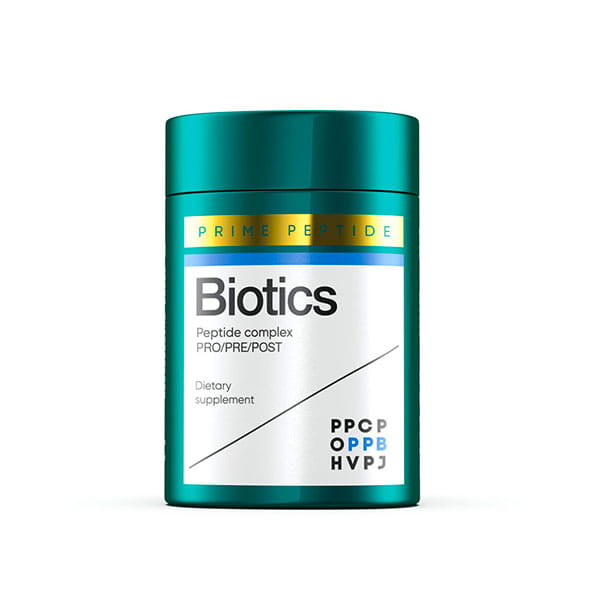
Prime Peptide® Biotics
category: natural peptide
barcode:
packing: 60 capsules
Gastrointestinal peptide with a live culture, prebiotic and postbiotic complex
Prime Peptide® Biotics combines a three-part biotic system — live lactic acid bacteria, a plant-derived prebiotic fibre and tyndallised postbiotic cultures with the low-molecular-weight gastroprotective peptide complex IPH AG. The formulation is directed at the intestinal lining: it supports the physiological renewal of the gastric and intestinal epithelium, contributes to the integrity of the mucosal barrier, and helps the digestive tract hold its equilibrium under stress and external load.
The rationale rests on a straightforward observation from cell biology. The intestinal epithelium is among the most rapidly renewing tissues in the human body; its cells are continuously replaced within a matter of days for a lifetime. That turnover requires both substrate and stable conditions. Prolonged stress, courses of antibiotics, irregular meals, alcohol and disrupted sleep all interfere with it. Barrier integrity declines, permeability rises, and the consequences appear gradually rather than suddenly: abdominal distension, heaviness after eating, irregular transit, reduced tolerance of foods that previously caused no difficulty at all.
IPH AG addresses this level directly. The intestinal peptide complex supports the regeneration of epithelial cells, helps maintain the architecture of the intestinal barrier, and supports the functional capacity of the villi, the absorptive structures that determine how efficiently nutrients are taken up rather than merely consumed. It also moderates pro-inflammatory cytokine activity within the mucosa and supports the local immune cells concentrated there, in the gut-associated lymphoid tissue that accounts for a substantial share of the body's entire immune apparatus.
The biotic component follows the logic of cultivation rather than intervention. Six characterised live Lactobacillus strains: acidophilus SGL11, rhamnosus SGL06, fermentum SGL10, kefiri SGL13, plantarum SGL07 and salivarius SGL03 — support the composition and activity of the intestinal microbiota. Inulin from chicory root (Cichorium intybus) provides their substrate; chicory is that pale blue plant familiar from field margins and roadside verges, cultivated for its root long before anyone could describe what its fructans actually do. Two tyndallised cultures, L. casei SGL15 and L. reuteri SGL01, complete the system: heat-inactivated cells that no longer replicate but retain their cell-wall structures and metabolites intact.
FIELD OF APPLICATION:
- maintenance and recovery of the gastric and intestinal mucosa
- compromised epithelial barrier and increased intestinal permeability
- dysbiosis, abdominal distension and digestive discomfort
- irregular intestinal transit and reduced nutrient absorption
- inflammatory reactions of the gastric and intestinal lining
- micro-inflammatory processes associated with prolonged stress
- diminished local immunity of the gastrointestinal tract
- restoration of the microbiota following antibiotic therapy
- support of intestinal villus function
- dietary disruption during travel or irregular working patterns
- age-related decline in digestive efficiency and comfort
BENEFITS:
The primary effect concerns the intestinal wall. IPH AG supports the structural restoration of the barrier and the renewal of epithelial cells throughout the digestive tract — from the gastric mucosa down to the small intestine, where the villi perform the actual work of absorption. A better-maintained barrier is more selective about what crosses it and what does not. This in turn supports the local immune response of the intestinal mucosa, which is no minor consideration: the gut-associated lymphoid tissue represents the largest concentration of immune cells in the body, and its workload depends directly on how much passes the barrier unchecked.
A calmer inflammatory background follows from this. Reduced pro-inflammatory signalling in the stomach and intestine means less of the low-grade irritation that renders digestion unpredictable and diminishes general wellbeing without ever presenting as a defined complaint. In parallel, the live Lactobacillus cultures and chicory inulin support microbial equilibrium — fewer manifestations of dysbiosis, less distension, more consistent transit. The tyndallised fraction contributes something else again: postbiotic support that remains functional under gastric acidity, concurrent antibiotic treatment, elevated storage temperatures or periods of physiological stress, precisely when live cultures are least likely to establish themselves. Its action does not depend on optimal conditions, which outside a laboratory is a distinction worth having.
ACTIVE COMPONENTS:
peptide complex IPH AG: L-alanine, L-glutamine, hydrolyzed protein; Inulin from chicory; corn maltodextrin; capsule shell: hydroxypropyl methylcellulose; color: copper complexes of chlorophyllins, E141(ii); probiotic blend: Lactobacillus acidophilus SGL11, L. rhamnosus SGL06, L. fermentum SGL10, L. kefiri SGL13, L. plantarum SGL07, L. salivarius SGL03; tyndallized non-viable probiotic cultures: L. casei SGL15, L. reuteri SGL01.
PACKING:
60 capsules by 32.7 mg / product: Prime Peptide Biotics / Non-GMO. It's not a medicinal drug.
Adults: two capsules daily, taken with a sufficient quantity of liquid.
The recommended course is one month and may be repeated as required.

